

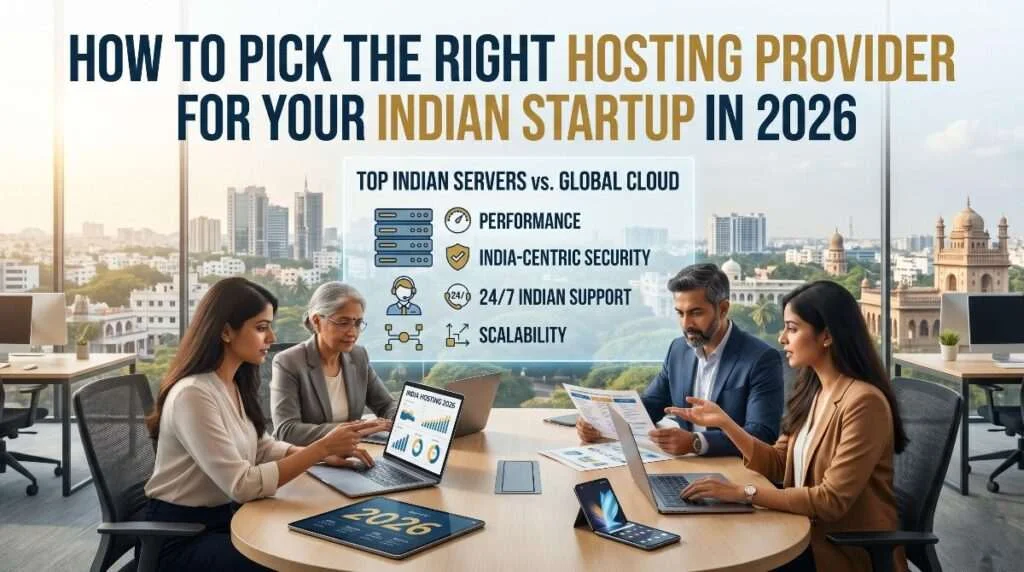
Choosing a hosting provider may look like a small technical decision when you are starting a business.
But for a startup, hosting is not just about putting a website online. It affects your website speed, customer experience, uptime, security, scalability, support, and monthly cost. If your hosting is weak, your website can become slow. Your application can crash during traffic spikes. Your customers may leave before they even understand what your product does.
For Indian startups, this decision is even more important.
India has a fast growing digital market. Customers expect websites, apps, dashboards, payment pages, and booking systems to load quickly. Founders also need hosting that is affordable, reliable, easy to scale, and backed by real support.
How do you pick the right hosting provider for your startup in India?
The answer is not “choose the cheapest plan.” The right hosting provider should match your startup’s current stage, growth plans, technical needs, customer location, and budget.
This guide will help you understand the key factors Indian startups should evaluate before choosing a web hosting provider.
Why Hosting Matters for Indian Startups
Many startups focus on product design, branding, marketing, and sales. Hosting is often treated as an afterthought. That is a mistake.
Your hosting provider becomes the foundation of your online business. Whether you are running a company website, SaaS platform, e-commerce store, learning portal, CRM, booking system, AI app, or customer dashboard, your hosting affects how users experience your product.
Bad hosting can cause:
- Slow website loading
- Frequent downtime
- Lost leads and sales
- Poor customer trust
- Security risks
- Email delivery problems
- Difficult migration later
- Higher costs as traffic grows
- Poor support during emergencies
For Indian startups, especially those targeting users in India, server location and support quality matter a lot. A hosting provider with Indian infrastructure and local support can often provide a better experience than a generic overseas provider.
The Biggest Mistake: Choosing Hosting Only by Price
Many founders start by searching for the cheapest hosting plan.
This is understandable. Startups have limited budgets. Every rupee matters.
But cheap hosting can become expensive later.
A low-cost plan may look attractive at first, but it may come with limits such as:
- Slow shared servers
- Poor CPU and RAM allocation
- Limited support
- No migration help
- High renewal charges
- Weak backup options
- Poor security features
- Limited scalability
- Hidden resource restrictions
For a simple personal blog, cheap hosting may work.
But for a startup, your website or application is part of your business. If it goes down during a product launch, ad campaign, investor demo, or customer onboarding, the damage can be much bigger than the money saved on hosting.
The better approach is to choose hosting based on value, not only price.
Ask yourself:
“Will this hosting provider support my startup when traffic grows, problems happen, and customers depend on my website?”
1. Check the Server Location
Server location is one of the most important factors for Indian startups.
If your customers are mostly in India, hosting your website on a server located in India can improve loading speed and reduce latency.
Latency means the delay between a user request and the server response. If your server is far away, such as in the US or Europe, every request has to travel a longer distance. This can make your website or app feel slower for Indian users.
For example, if your startup serves customers in Assam, Delhi, Mumbai, Bengaluru, Kolkata, Hyderabad, Pune, or other Indian cities, then Indian hosting can give a better local experience.
This is especially useful for:
- Startup websites
- SaaS platforms
- E-commerce stores
- Educational portals
- Local service websites
- Booking platforms
- Healthcare apps
- Customer dashboards
- Business applications
A nearby server can help with faster response times, smoother browsing, and better user experience.
If your startup is focused on Indian users, you should ask your hosting provider:
Where exactly are your servers located?
Do not assume every Indian hosting company has servers in India. Some companies are Indian businesses but use foreign data centers. That may not give you the local hosting advantage you are looking for.
2. Evaluate Uptime and Reliability
For startups, downtime is not just a technical issue. It is a business issue.
If your website is down, customers cannot contact you. Leads stop coming. Orders fail. Users lose trust. Your team may waste hours fixing problems instead of growing the business.
That is why uptime should be a major factor when choosing a hosting provider.
Look for:
- Strong uptime commitment
- Reliable data center infrastructure
- Backup power
- Network redundancy
- Server monitoring
- Quick incident response
- Clear support process
Do not only look at marketing claims. Ask practical questions:
- What happens if the server goes down?
- Is support available during emergencies?
- Do they monitor servers?
- Is there backup power?
- Do they have multiple network providers?
- How fast do they respond to critical issues?
3. Choose Hosting That Can Scale With Your Startup
Many startups begin with basic shared hosting, but quickly outgrow it. As traffic increases, you may need more CPU, RAM, storage, bandwidth, or dedicated resources.
A good hosting provider should offer multiple upgrade paths, such as:
- WordPress VPS
- VPS Hosting
- Dedicated Servers
- Cloud or high-performance servers
- GPU Servers for AI/ML workloads
- Windows RDP or Windows Servers
- Colocation for companies with their own hardware
Scalability means you should not be forced to migrate to a completely different provider every time your business grows.
4. Look at Support Quality, Not Just Support Availability
Many hosting companies say they offer support.
But there is a big difference between real technical support and slow ticket replies.
When something breaks, you need a team that can understand the issue and guide you properly.
For Indian startups, local support can be a major advantage. You may need help with DNS, SSL, migration, server setup, website errors, email issues, backup restoration, or performance problems.
Good support should be:
- Fast
- Human
- Technical
- Clear
- Available during urgent situations
- Able to explain things in simple language
- Helpful during migration and scaling
For non-technical founders, support quality becomes even more important. You may not have an in-house DevOps team in the early stage. In that case, your hosting provider’s support team becomes your first line of technical help.
Before choosing a provider, check:
- Do they only provide chatbots?
- Do they offer real human support?
- Can they help with website migration?
- Do they understand VPS, dedicated servers, DNS, SSL, and server security?
- Do they support Indian customers properly?
- Are they reachable when urgent problems happen?
A startup should never choose a provider that disappears when something goes wrong.
5. Understand the Type of Hosting You Actually Need
The right hosting depends on your business model, traffic, website type, and technical requirements.
Here is a simple breakdown.
Shared Hosting
Shared hosting is the cheapest option. Multiple websites share the same server resources.
It can work for very small websites, basic landing pages, or early testing. But it may not be ideal for serious startup applications because performance and control are limited.
Best for:
- Simple brochure websites
- Very early-stage websites
- Testing ideas
- Low-traffic pages
Not ideal for:
- SaaS platforms
- High-traffic websites
- E-commerce stores
- Custom apps
- Startups needing strong performance
VPS Hosting
VPS Hosting gives you dedicated virtual resources. It is better than shared hosting because you get more control, better performance, and easier scaling.
For many Indian startups, VPS is the best starting point.
Best for:
- Startup websites
- WordPress websites
- SaaS MVPs
- Business applications
- Developer projects
- Client portals
- Growing websites
A VPS gives better flexibility without the higher cost of a dedicated server.
WordPress VPS
If your startup website is built on WordPress, a WordPress VPS can give better performance than normal shared hosting.
It is useful for:
- Startup websites
- Blogs
- Landing pages
- Company websites
- Content marketing websites
- Service business websites
With proper optimization, WordPress VPS can handle better traffic and provide faster loading.
Dedicated Server
A dedicated server gives your startup full physical server resources.
This is suitable when you need high performance, better control, more traffic capacity, or stronger isolation.
Best for:
- High-traffic websites
- SaaS platforms
- Enterprise applications
- Large databases
- Heavy backend systems
- Agencies hosting many clients
- Businesses needing full server control
Dedicated servers cost more than VPS, but they provide better power and control.
GPU Server
If your startup works with AI, machine learning, video processing, rendering, or heavy computing, GPU servers may be required.
Best for:
- AI startups
- ML model training
- Inference workloads
- Video rendering
- Computer vision projects
- Research workloads
- Automation platforms
For AI-focused startups in India, GPU hosting can be a major requirement as the product grows.
Colocation
Colocation is for startups or companies that own physical servers and want to place them inside a data center.
The provider gives rack space, power, cooling, network, and infrastructure.
Best for:
- Companies with own servers
- Infrastructure-heavy startups
- Hosting companies
- Enterprises
- Data-sensitive workloads
- Long-term infrastructure planning
Most early-stage startups may not need colocation immediately, but it becomes useful for companies that want full hardware ownership.
6. Check Pricing Transparency
Many hosting providers offer low starting prices and then increase renewal costs later. Some charge extra for basic things like backups, SSL, support, migration, control panels, or bandwidth.
Before buying hosting, check:
- Monthly price
- Renewal price
- Setup fee
- Backup cost
- Control panel cost
- Migration charges
- Extra storage cost
- Bandwidth limits
- Support limitations
- GST and invoice details
- Upgrade cost
Indian startups should also consider whether the provider offers INR billing. Paying in Indian rupees makes accounting easier and avoids currency conversion issues.
Transparent pricing is better than cheap pricing.
7. Check Security and Backup Options
Security should not be ignored, even in the early stage.
Startups often store customer data, leads, payment records, login details, business documents, or user activity. A weak hosting setup can expose your business to serious risk.
Check whether the hosting provider supports:
- SSL certificates
- Firewalls
- Malware protection
- DDoS protection
- Regular backups
- Server monitoring
- Secure SSH access
- Updated server software
- Access control
- Backup restoration support
Backups are especially important.
A backup is not useful unless it can be restored when needed. Ask your provider:
- Are backups automatic?
- How often are backups taken?
- Where are backups stored?
- Can I restore them easily?
- Is backup included or paid?
- Do you help with restoration?
For startups, backup planning can save the business during accidents, hacking, bad updates, or developer mistakes.
8. Think About Compliance and Data Locality
Data locality means where your business data is stored.
For many Indian startups, especially in sectors like fintech, healthcare, education, SaaS, government services, and enterprise software, data location can become important.
Not every startup is legally required to host in India. But keeping data inside India can help with internal policies, customer confidence, vendor requirements, and future compliance planning.
This is especially useful if you work with:
- Indian customers
- Indian enterprises
- Government-related clients
- Healthcare data
- Financial workflows
- Education platforms
- Local business data
- Sensitive customer records
If your startup expects to serve Indian businesses or institutions, choosing an Indian hosting provider can make your infrastructure story stronger.
9. Check Migration Support
Many startups already have a website or application hosted somewhere else.
Maybe it is on shared hosting. Maybe it is on a US server. Maybe it is with a freelancer’s hosting account. Maybe it is on a global cloud provider that has become expensive.
In such cases, migration support is very important.
A good hosting provider should help you move:
- Website files
- Databases
- Emails
- DNS records
- SSL certificates
- Control panel settings
- Application files
- WordPress setup
- Cron jobs
- Custom configurations
If you are moving from the US to India, proper migration planning can help reduce downtime.
Before choosing a provider, ask:
- Do you help with website migration?
- Can you migrate WordPress?
- Can you migrate databases?
- Can you help with DNS changes?
- Can you test the website before going live?
- Can you help move email accounts?
- How do you avoid downtime?
For startups, migration support saves time and reduces risk.
10. Look for Performance Features
Performance depends on many things, including website code, images, database optimization, caching, CDN, and hosting infrastructure.
When choosing a hosting provider, check the performance side:
- NVMe SSD storage
- Modern processors
- Adequate RAM
- Good network quality
- Caching support
- CDN compatibility
- Server-level optimization
- LiteSpeed, Nginx, or Apache support
- PHP version support
- Database performance
- Resource isolation
If you run WordPress, performance also depends on themes, plugins, image size, and caching.
11. Make Sure You Have Control
Some hosting providers give very limited control. That may be fine for beginners, but startups often need flexibility.
Depending on your startup, you may need:
- SSH access
- Root access
- Custom software installation
- Database control
- Firewall settings
- Cron jobs
- API deployment
- Docker support
- Node.js, Python, PHP, or other runtime support
- Git deployment
- Custom server configuration
If your startup has developers, they may need more control than shared hosting can provide.
For technical startups, VPS or dedicated servers are usually better because they allow more customization.
12. Compare Hosting Providers Using a Simple Framework
Here is a simple comparison framework Indian startups can use before choosing a hosting provider.
| Factor | What to Check | Why It Matters |
| Server Location | Is the server located in India? | Better speed for Indian users |
| Uptime | Does the provider offer reliable infrastructure? | Keeps your startup online |
| Scalability | Can you upgrade from VPS to dedicated or GPU? | Supports future growth |
| Support | Is real technical support available? | Helps during urgent problems |
| Pricing | Is pricing transparent in INR? | Avoids hidden cost and renewal shocks |
| Security | Are SSL, firewall, and backups supported? | Protects business and customer data |
| Migration | Does the provider help move your website? | Reduces downtime and risk |
| Performance | Are NVMe, modern CPUs, and good network available? | Improves user experience |
| Control | Do you get enough server access? | Useful for developers and custom apps |
| Data Locality | Can your data stay in India? | Helps with trust and compliance planning |
Where NCXHost Fits for Indian Startups
For Indian startups looking for reliable, scalable, and locally rooted hosting, NCXHost can be a strong choice.
NCXHost is known as Assam’s First Indigenous Data Center and provides hosting solutions for businesses, developers, startups, and organizations that want infrastructure based in India.
For startups, NCXHost offers multiple hosting options, including:
This gives startups flexibility.
A small startup can begin with VPS or WordPress VPS. As the product grows, it can move to a dedicated server. If the startup works with AI or machine learning, GPU servers can support heavier workloads. If the company later wants to host its own physical servers, colocation can become an option.
This type of growth path is important because startups should not have to change providers every time they scale.
NCXHost is also useful for businesses that want:
- Indian hosting infrastructure
- Local support
- Better performance for Indian users
- Migration help
- Cost-effective alternatives to expensive global cloud platforms
- Hosting options for websites, applications, and business platforms
For startups in Assam, Northeast India, and the wider Indian market, NCXHost gives a practical local advantage.
Questions to Ask Before Buying Hosting
Before you select a hosting provider, ask these questions:
- Where are your servers located?
- Do you provide Indian data center hosting?
- What uptime commitment do you provide?
- Do you help with website migration?
- Is support handled by real technical people?
- What happens if my website goes down?
- Can I upgrade my server later?
- Do you provide backups?
- Is SSL included?
- Are there hidden charges?
- Do you bill in INR?
- Can I host WordPress, custom apps, or SaaS platforms?
- Do you offer VPS, dedicated servers, GPU servers, or colocation?
- Can you help me move from my current provider?
- What security features are included?
The answers will help you separate serious hosting providers from low-quality ones.
Frequently Asked Questions
1. How do I pick the right hosting provider for my startup in India?
To pick the right hosting provider for your startup in India, check server location, uptime, scalability, support quality, pricing, security, backup options, and migration help. If your customers are mainly in India, choosing a provider with Indian infrastructure can improve speed and user experience.
2. Which hosting is best for Indian startups?
For most Indian startups, VPS Hosting is a good starting point because it offers better performance, control, and scalability than shared hosting. WordPress VPS is suitable for WordPress websites, while dedicated servers are better for high-traffic platforms. AI startups may need GPU servers.
3. Should Indian startups choose servers located in India?
Yes, if most of your users are in India, servers located in India can reduce latency and improve website loading speed. This is useful for business websites, SaaS platforms, e-commerce stores, dashboards, and customer portals.
4. Is shared hosting enough for a startup?
Shared hosting may be enough for a simple landing page or very small website. But for serious startup websites, SaaS platforms, e-commerce stores, or custom applications, VPS Hosting is usually a better choice.
5. Why is local support important for Indian startups?
Local support helps Indian startups solve hosting issues faster. It also makes communication easier, especially during website migration, downtime, DNS problems, SSL setup, or server errors.
6. What is the best hosting option for a SaaS startup in India?
A SaaS startup should usually start with VPS Hosting or a dedicated server, depending on traffic and resource needs. The hosting should support scaling, database performance, backups, security, and developer access.
7. Can I move my startup website from US hosting to Indian hosting?
Yes. You can move your website from US hosting to Indian hosting by taking a full backup, setting up the new Indian server, transferring files and databases, testing the website, reducing DNS TTL, and updating DNS records. A good hosting provider can help with migration.
8. Why should startups consider NCXHost?
Startups can consider NCXHost because it offers Indian hosting infrastructure with VPS Hosting, WordPress VPS, Dedicated Servers, GPU Servers, Windows RDP, and Colocation services. It is especially useful for startups looking for local support, scalable hosting options, and better performance for Indian users.
Conclusion
Picking the right hosting provider for your Indian startup is not only about price. It is about performance, uptime, support, scalability, security, and long-term growth.
If your startup serves Indian users, choosing hosting infrastructure located in India can help improve speed, reduce latency, and provide a better customer experience. Local support and INR billing can also make operations easier for founders.
Start with your current needs, but think about future growth.
A simple website may need WordPress VPS today. A growing SaaS platform may need VPS or dedicated servers tomorrow. An AI startup may need GPU servers. A larger infrastructure company may eventually need colocation.
That is why choosing a provider with multiple hosting options is important.For Indian startups, especially those in Assam, Northeast India, and businesses targeting Indian customers, NCXHost offers a strong local hosting option with scalable infrastructure, local support, and hosting solutions built for modern business needs.